
South Korea, a nation that rose from the ashes of war to become a global leader in technology and culture, is a land of fascinating contrasts. Before we dive into its 5,000-year history, let’s explore the essential facts and figures that define the Republic of Korea in the 21st century.
1. Geography and Strategic Location
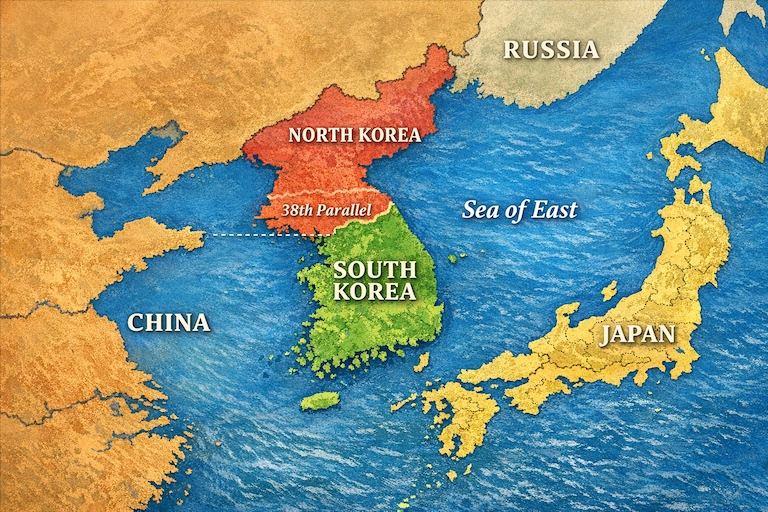
Strategically positioned as a bridge between the Asian continent and the Pacific Ocean, South Korea occupies the southern half of the Korean Peninsula.
- Geographic Coordinates: Approximately 33°N to 39°N latitude and 124°E to 130°E longitude.
- Total Area: Approximately 100,412 km². Despite its relatively small size (similar to Iceland or Portugal), it exerts significant global influence.
- Topography: About 70% of the land is mountainous, with the most famous range being the Taebaek Mountains running along the east coast.
2. Economic Powerhouse
Often referred to as the “Miracle on the Han River,” South Korea’s economic transformation is unprecedented.
- GDP (Gross Domestic Product): Ranked within the Top 13 globally, with a nominal GDP of approximately 1.8 to 1.9 trillion USD.
- GNI per Capita: Surpassing the 35,000 USD mark, reflecting a high standard of living.
- Global Leaders in Industry: Home to world-class corporations like Samsung, Hyundai, and SK, dominating sectors such as semiconductors, electric vehicles, and shipbuilding.
3. Demographics and Language
- Population: Approximately 51.7 million people. While facing challenges with a low birth rate, South Korea remains one of the most densely populated and digitally connected nations.
- Official Language: Korean (Hangeul). Invented by King Sejong the Great in 1443, Hangeul is widely regarded by linguists as the most scientific and logical writing system in the world.
4. Climate and the Four Seasons
One of Korea’s most beautiful features is its four distinct seasons, each offering a unique landscape:
- Spring (March–May): Mild temperatures and the iconic blooming of cherry blossoms.
- Summer (June–August): Hot and humid, featuring the “Jangma” (monsoon) season and vibrant beach culture.
- Autumn (September–November): Crisp air and stunning crimson and gold foliage—arguably the best time to visit.
- Winter (December–February): Cold, dry, and snowy, perfect for winter sports and traditional hot-stone floor heating (Ondol).
Summary for Global Readers
South Korea is a dynamic nation where high-tech innovation meets deep-rooted tradition. Strategically located at the crossroads of Northeast Asia, it has transformed from a war-torn country into a global economic powerhouse (ranked in the Top 15 GDP worldwide).
With its scientific writing system ‘Hangeul’, a population of 51 million, and four beautiful seasons, Korea offers a unique cultural landscape. This post serves as the foundation for our upcoming journey through Korean history—from the mythical founding of the nation to its modern-day global influence.