
Every great civilization has its origin story. For Korea, it begins over 4,300 years ago with a celestial prince, a patient bear, and a sacred vision to “broadly benefit the human world.” This is the story of Gojoseon, the first Korean kingdom, and its mythical founder, Dangun Wanggeom.
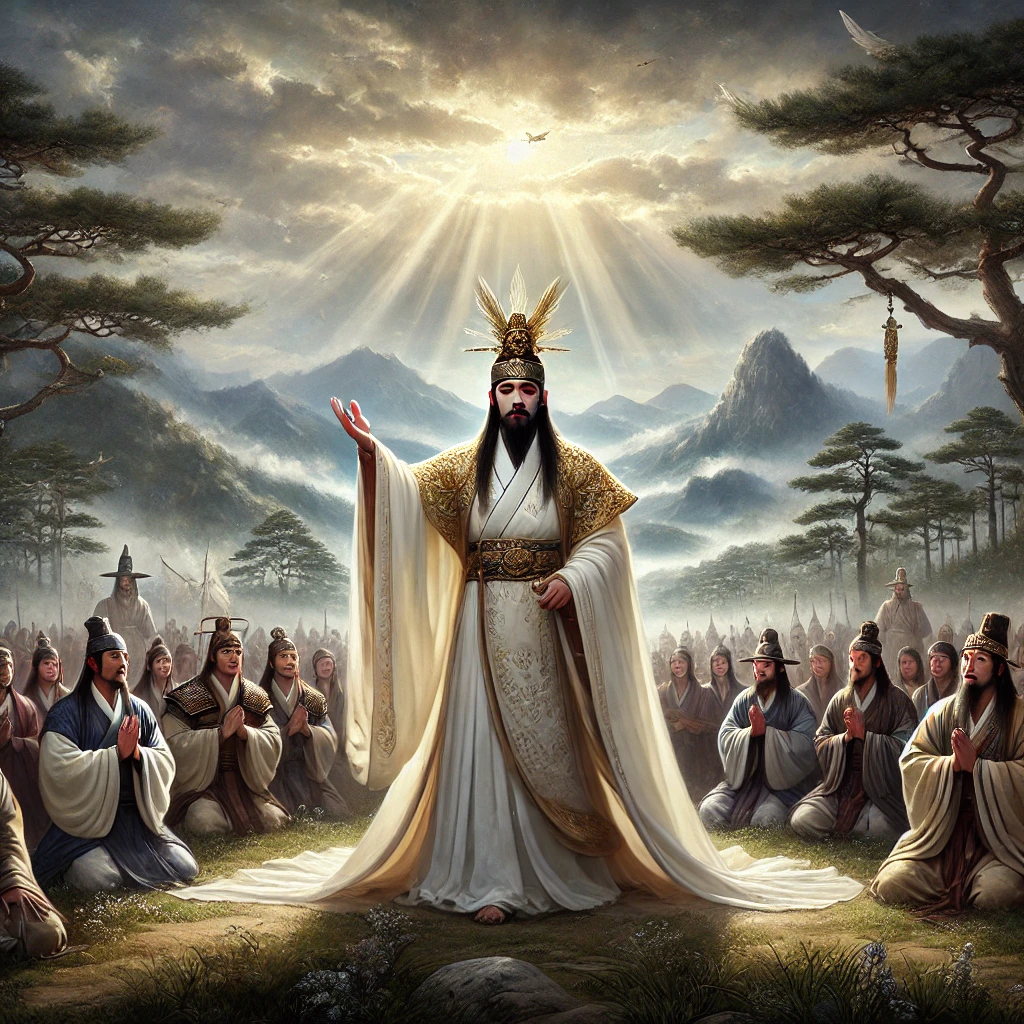
1. The Descent of Hwanung
The story begins in heaven. Hwanung, the son of the Lord of Heaven (Hwanin), yearned to live among humans. Seeing his son’s desire, Hwanin allowed him to descend to Earth.
Hwanung arrived at Mount Taebaek (believed to be Mt. Paektu today) accompanied by 3,000 followers and three elemental masters: the Lord of Wind, the Master of Rain, and the Master of Clouds. Together, they governed over 360 human affairs, including agriculture, life, disease, and justice, establishing a civilized society.

2. The Trial of the Bear and the Tiger
While Hwanung ruled, a bear and a tiger lived in a nearby cave. Both prayed to Hwanung to be transformed into human beings. Hwanung decided to give them a divine test:
“Stay in a dark cave for 100 days, avoiding the sunlight, and eat only these 20 cloves of garlic and a bundle of mugwort.”
The tiger, being restless and hungry, soon gave up and fled the cave. However, the bear remained patient. After only 21 days, the bear’s endurance was rewarded, and she transformed into a beautiful woman named Ungnyeo.
3. The Founding of Gojoseon (2333 BCE)
Ungnyeo later married Hwanung and gave birth to a son named Dangun Wanggeom.
In 2333 BCE, Dangun established a kingdom called Gosejeon (meaning “Land of the Morning Calm”) in the basin of the Liao River and the Taedong River. He ruled with the philosophy of Hongik Ingan, which means “to broadly promote the benefit of all mankind.” This spirit remains the core of Korean national identity even today.
Why This Story Matters Today
- The Spirit of Hongik Ingan: This founding philosophy is still the official educational motto of modern South Korea. It emphasizes humanitarianism and world peace.
- National Foundation Day: Every October 3rd, Koreans celebrate Gaecheonjeol (The Day the Sky Opened) to commemorate Dangun’s founding of the nation.
- Cultural Symbolism: The bear is often seen as a symbol of patience and perseverance in Korean culture—traits that many believe helped the nation survive its long and turbulent history.