
While the legend of Dangun provides a spiritual foundation, historical records reveal that Gojoseon was a sophisticated, organized state. It wasn’t just a tribal gathering; it was a powerful kingdom with a clear legal system, advanced technology, and a distinct social hierarchy.
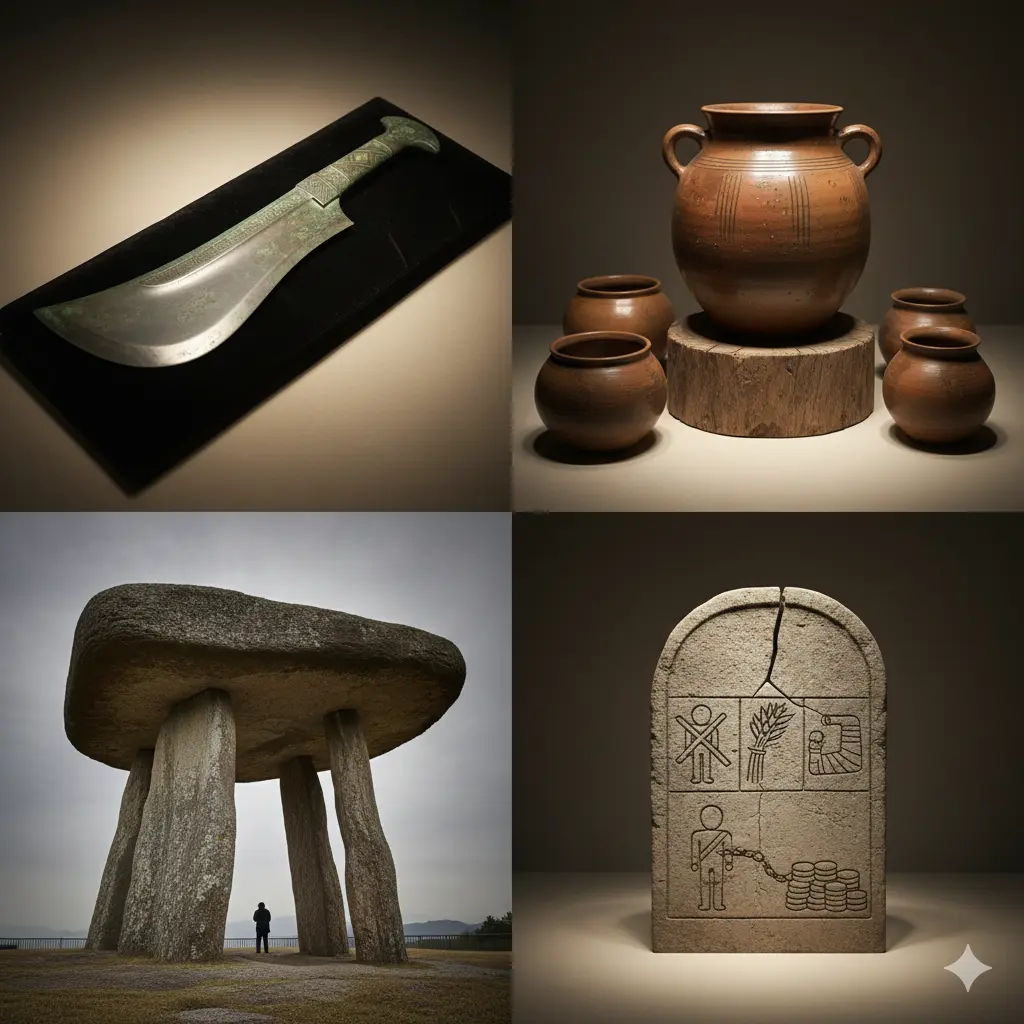
1. The Code of Eight Laws (Eight Prohibitions)
Gojoseon was a society governed by law. Although only three of the original eight laws are recorded in ancient Chinese texts (the Book of Han), they reveal a lot about their values:
- “If you kill a person, you shall be put to death immediately.” (Protection of life and labor)
- “If you injure another, you must compensate them with grain.” (Importance of agriculture and private property)
- “If you steal, you shall become the slave of the victim, unless you pay a large fine.” (Strict social classes and the concept of atonement)
2. Advanced Bronze and Iron Culture
Gojoseon’s power was backed by its technological edge. They were masters of metallurgy.
- Mandolin-shaped Bronze Dagger (Bipa-hyeong Donggeom): This uniquely shaped weapon is the hallmark of Gojoseon’s cultural reach, found across the Korean Peninsula and parts of Manchuria.
- Misong-ri style Pottery: A specific type of pottery with handles that helps archaeologists map the kingdom’s territory.
- Dolmens: The massive stone tombs found in Korea signify the presence of a powerful ruling class capable of mobilizing a large workforce.
3. A Centralized Political Structure
Gojoseon evolved from a tribal confederation into a centralized kingdom with a clear bureaucracy.
- Titles of Nobility: Historical records mention official titles such as Sang (Minister), Daebu (Grandee), and General. This proves the existence of a structured government.
- Wiman Joseon: Later in its history, Gojoseon adopted iron culture more aggressively, expanding its territory and controlling trade routes between China and other southern tribes.